
December 10, 2023 by jayneanastasia Leave a comment
Decades: The Bee Gees – A Book Series
On December 3, 2023, Barry Gibb was celebrated for his lifetime artistic achievements as one of the Honorees at The Kennedy Center Honors held at The Kennedy Center in Washington, D.C. Barry has achieved a level of songwriting that is not just prolific, but chart topping, and award winning. He along with brothers Robin and Maurice made up the musical group the Bee Gees and their music has spanned over 50 years.
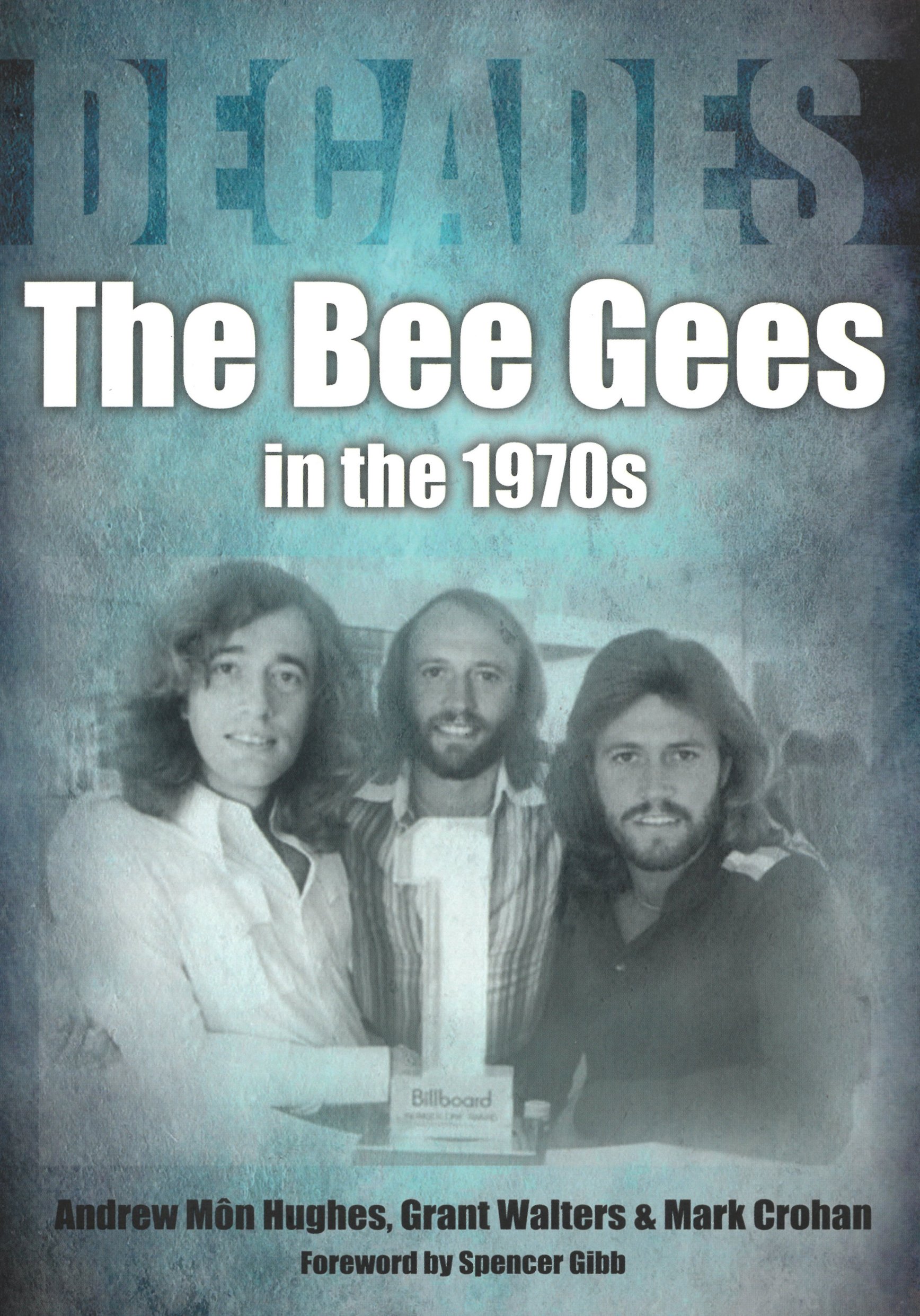
The catalog of the brothers Gibb music (as Bee Gees and solo work) is so vast, documenting it would be a monumental task. So monumental in fact, that publishing the contents would take multiple books. Well, as luck would have it, I just happen to be acquainted with the gentlemen who are working on that monumental task! These three gentlemen’s work is being published in a series of books entitled Decades: The Bee Gees, and to start us off, here is a description from the Decades website…
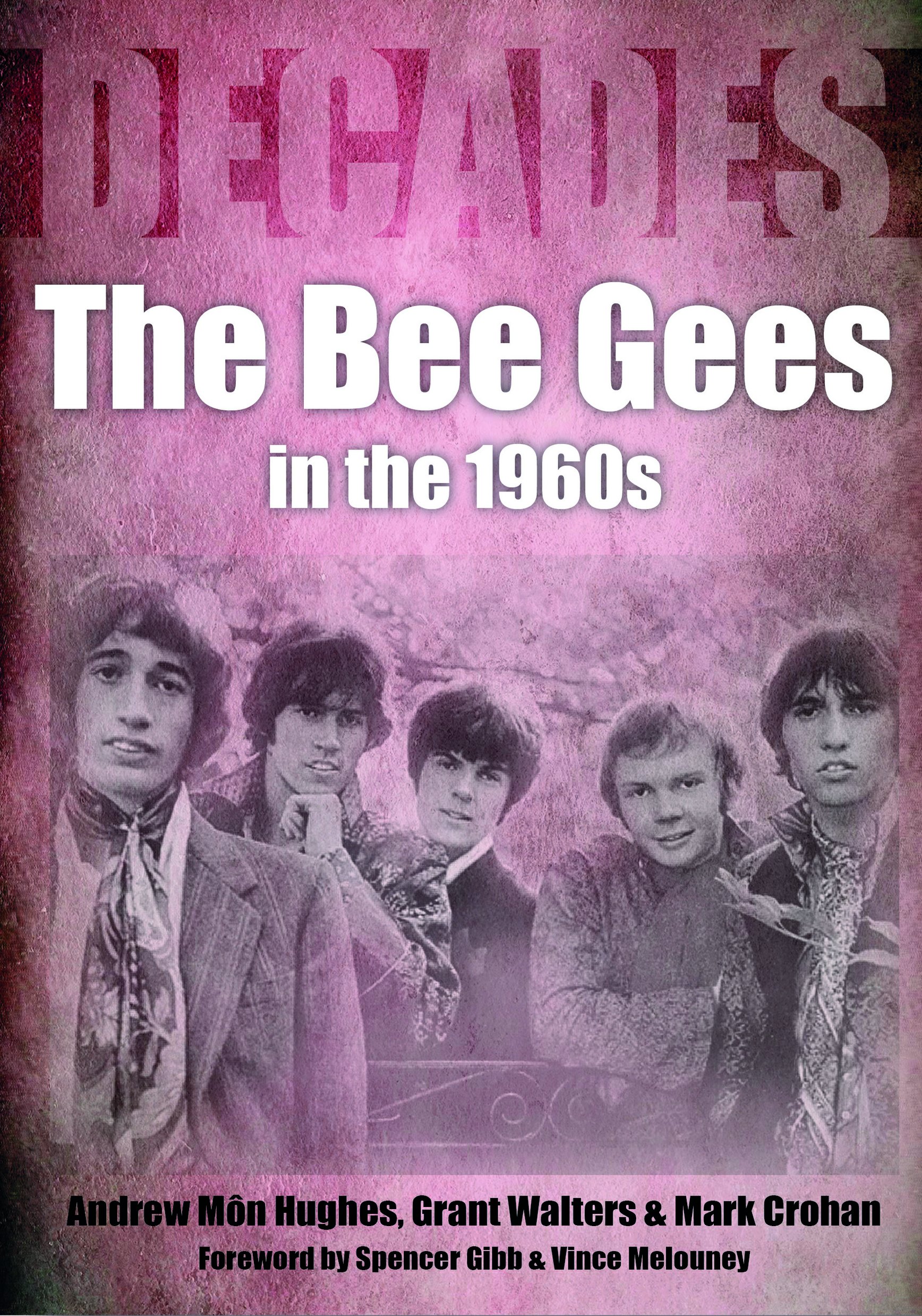
DECADES: THE BEE GEES is the first published set of volumes to chronicle the band’s stunning catalog album-by-album, and song-by-song – including expansive commentary on the brothers’ solo efforts, production work, and side projects.
With so much work and detail going into these volumes, I thought we really should have an opportunity to get more acquainted with the authors! This Feature sets out to introduce everyone to the three authors behind the successful series, Decades: The Bee Gees. Already having published the first two of the four books in the series, covering the 1960s and the 1970s respectively, these gentlemen have created the most extensive and informative documentation of Bee Gees music anywhere. To say that they are THE authority on the subject is stating it mildly. To be honest, when contemplating doing this Feature, I was a bit overwhelmed. I can only imagine how the authors have felt while working on the books. We will journey further down the road covering the individual books content in the future, but for this Feature, we will focus on the authors and begin with a press release for the authors’ recent table talk events…
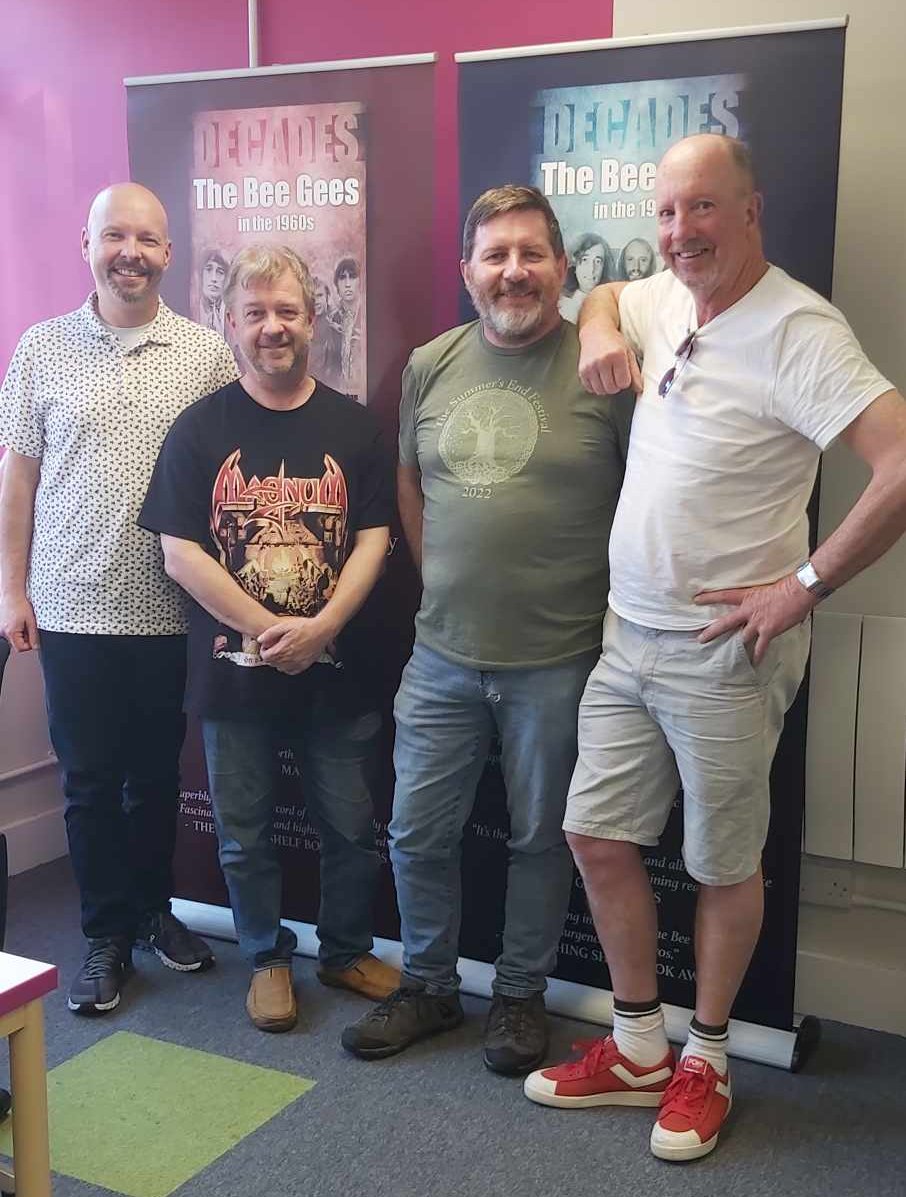
Based in Wales, the United States, and Australia, respectively, Andrew Môn Hughes, Grant Walters, and Mark Crohan have over fourteen decades of combined expertise and history tied to the Bee Gees’ legacy between them, amassing a lengthy list of credits for their contributions to CDs, DVDs, books, tour programs, articles, television documentaries, and official websites.
Now! Let’s meet each of the authors!
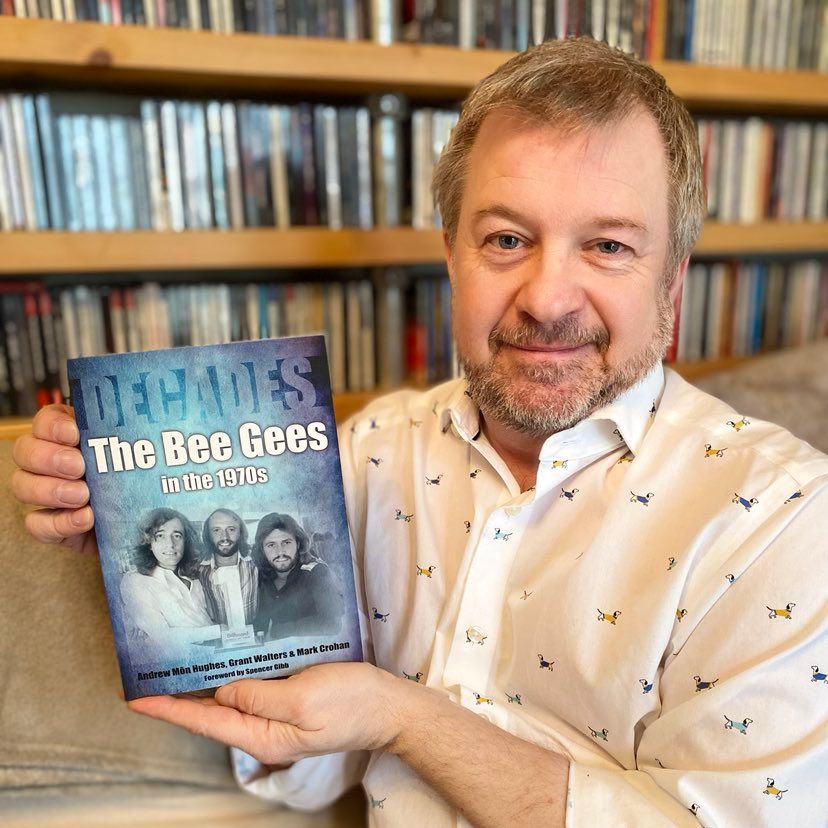
Andrew Môn Hughes, was born and raised in the enchanting surroundings of Anglesey, Wales. Andrew‘s journey into the world of music and writing began with an early fascination with the Bee Gees. His profound interest in their music and their intricate journey from humble beginnings to international stardom drove him to become a leading authority on the subject. Over the years, Andrew has researched and chronicled the remarkable story of the Brothers Gibb. His expertise has culminated in a series of comprehensive books that have become essential references for fans and scholars alike. He may also be seen and heard in a myriad of Bee Gees-related productions for the BBC, ITV, A&E, and VH1 networks.
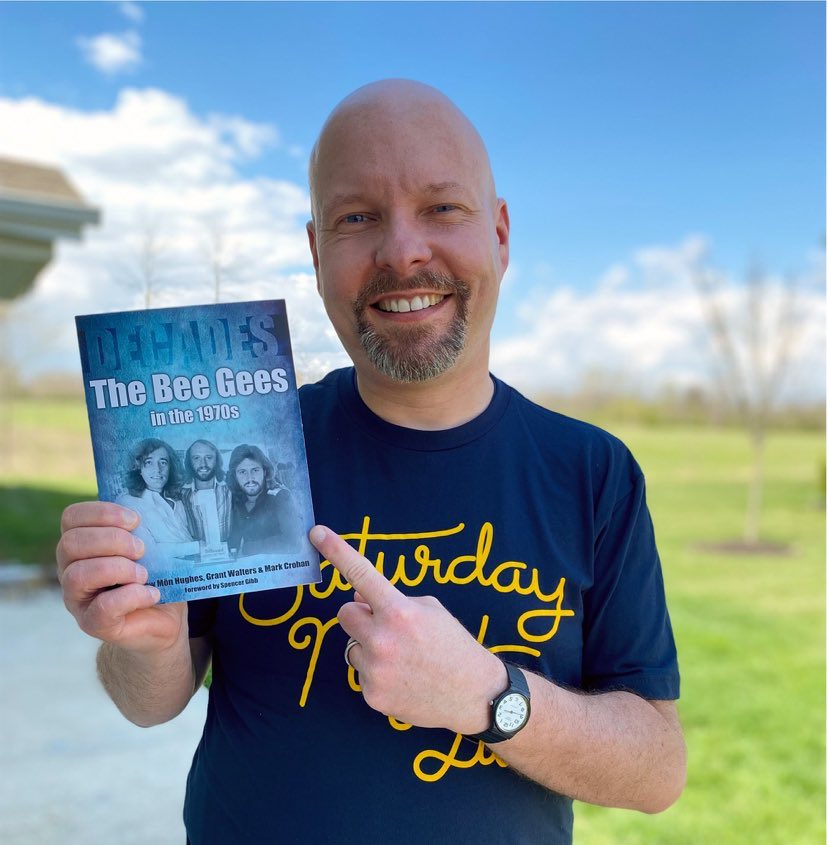
Grant Walters, who is Canadian-born and now lives in the United States, had written for professional publications on and off and had done a lot of marketing and communications experience work throughout his career in higher education, but he started to write freelance music and comedy articles in his spare time for a couple of outlets about eight years ago. It didn’t take long before he started to interview high-profile artists for his features. He’s interviewed Ben Folds, Dionne Warwick, Styx, Barenaked Ladies, Midge Ure, Melissa Etheridge, Bryan Adams, among many others. He’s been a Bee Gees fan since he was about three years old, and he actually started the original Bee Gees email Listserv (which used to be called Jive Talkin’), so we had all originally connected in that forum before social media ever existed.
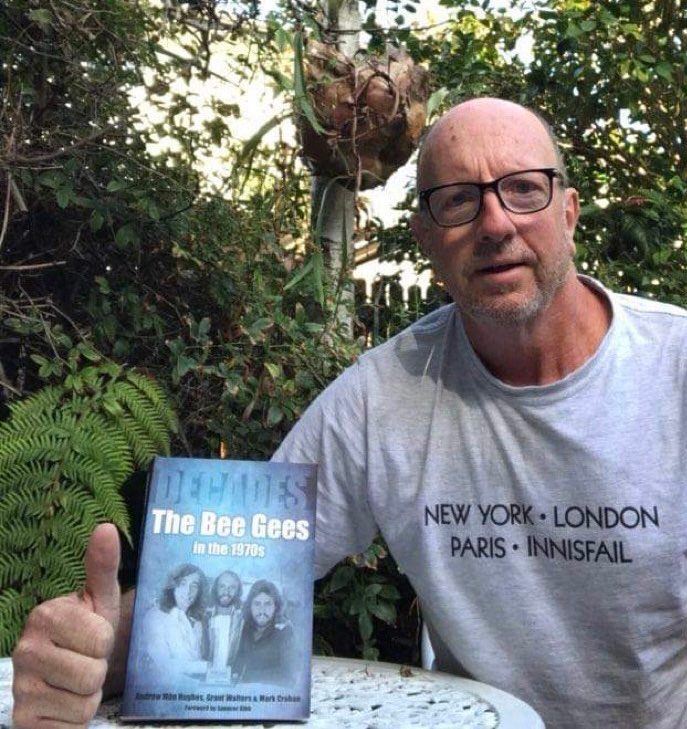
Mark Crohan, from Melbourne, Australia at 68 is the oldest member of the team and has been a big fan since 1966. As a fan he has ridden the highs and lows of the Bee Gees extraordinary career quite personally. He is highly regarded not only for his knowledge on the Bee Gees’ Australian era but on the Australian music scene in general in the sixties and seventies. Until he gifted his collection to the Queensland Library in 2016, he owned the most complete Bee Gees/Gibb collection in Australia. He produced and wrote the liner notes to the highly regarded 1998 compilation Assault the Vaults. Andrew and Mark have been working together on various Bee Gees projects since 1998.
For this Feature, I knew an introduction to the authors would be needed. Not just to get to know them, but to be able to also identify the perspective the individual answers were coming from. The questions were posed to each of the three gentlemen and they responded to what they felt they had some input on. The questions are in bold, followed by their comments indicated individually by their names.
My understanding is that the Decades series, published by Sonicbond Publishing, is a group of books written by different authors each covering various musicians/bands whose work has been significant enough to impact multiple decades. Who initially came up with the idea to pursue doing a series?

Andrew: The whole thing began during COVID lockdown. A couple of friends of mine, Keith and Monika Domone, wrote and published their second book about one of my favorite bands, Barclay James Harvest. It was part of Sonicbond Publishing’s On Track series, and I figured that there was potential for a similar volume on the Bee Gees. I was conscious that all my previous big writing projects had been collaborative efforts, and I felt it would be better to continue that trend with this book, so I asked Grant and Mark if they would like to join me, and without any hesitation, both jumped at the opportunity.
I actually got the publishing deal before assembling the writing team, but it was a no-brainer as to who I was going to ask. The combined knowledge of the team is vast, and conveniently we all have different favorite periods of The Bee Gees’ career. Combine that with our different cultural backgrounds and you’re getting a very balanced view on every aspect of their music and career, and we hope this translates into an interesting narrative.
Once you were each on board, how did you, Grant and Mark receive the go-ahead to tackle the Decades books covering the history of the Bee Gees and their discography?
Andrew: I made an approach to the publisher and sealed the deal. The On Track books are usually in the region of 65,000 words, and we realized quite early on that it would be a challenge to do justice to the Bee Gees catalog being restricted to this, so I asked the publisher if we could possibly bump it up to 100,000 words, to which he somewhat reluctantly agreed.
Appreciative of the additional wordage afforded to us, we continued to write, but realized when we topped 144,000 words that we had a bigger problem than we had originally anticipated!
I spoke to the publisher about our dilemma, and he suggested that we split the book. As Sonicbond had already published a book about Elton John covering 1969-1979, I figured that the Bee Gees career would split quite nicely into two parts, 1963-1974 and 1975-2020, both in terms of it being a transitional point in their career, and, also importantly, it gave us word count balance up to that point, with scope to develop the text further.
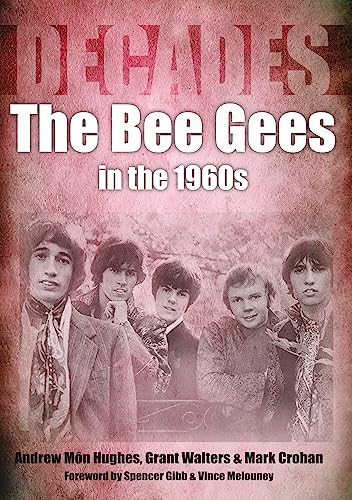
Anyway, as excited as I was with my idea, it was not to be! The publisher announced that they had started another book series called Decades – which is self-explanatory. He wanted to split the Bee Gees career to make three books: 1960s, 1970s and 1980s. I argued our case to expand this to include the 1990s, which he accepted, and this is where we currently stand.
By the time we’re done, in terms of word count, we’ll be close to half a million words!
Can you share what each writer’s main area is to cover, as in their focus such as research or writing aspects. Or do you divide the years up and each tackle a section?
Andrew: I’ve always loved researching the Bee Gees career, digging deeper and deeper just to find that little snippet of additional detail to an already well-known part of the story.
I have so many amazing resources available to enable me to do this, and as an example, I’ve already scoured every single edition of Billboard and Music Week magazines from the 80s for relevant information, much of which didn’t filter through into the mainstream music magazines.
I’ll set up the work documents and then it’s a free for all when it comes to the initial shaping of this into a narrative form.
How did you decide on who to approach to write the forewords?
Grant: Well, we discussed between us who would be appropriate and hopefully willing to do so. Also their reliability to write a foreword in the required timeframe is also considered.
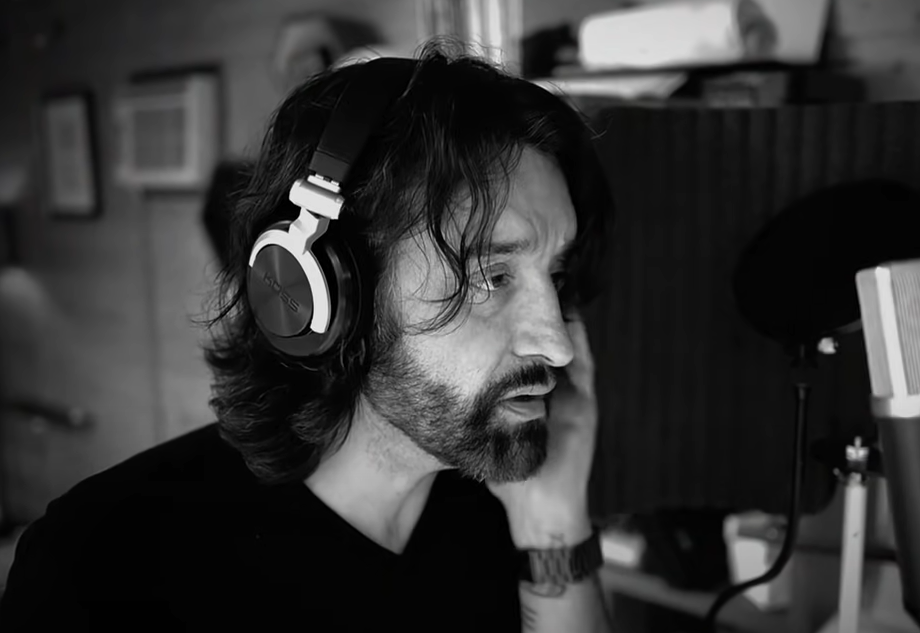
In your first and second instalments of Decades – The Bee Gees, Spencer Gibb (son of Robin Gibb) has written a foreword. What was Spencer‘s reaction when approached about the project and was presented with an opportunity to write a foreword as well?
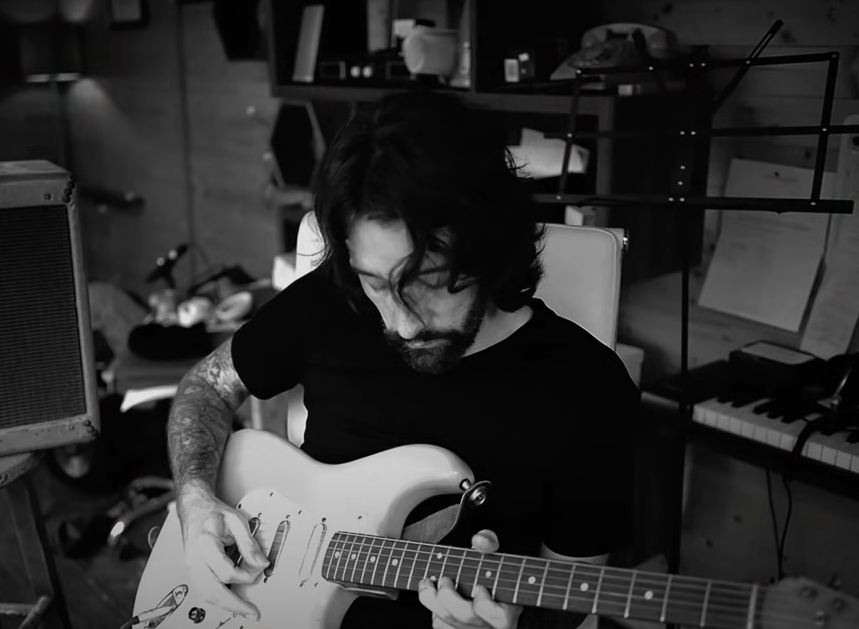
Grant: Spencer and I had already struck up a friendship when we collaborated for a few articles, one of which was a deep dive into Spencer’s most recent studio album, Let’s Start Over. The two of us have a lot in common as music enthusiasts, so asking Spencer to write forewords for the first two books was an easy, natural decision. He was absolutely enthusiastic and appreciated the hard work we were investing in chronicling his family’s legacy. Spencer is a working musician, producer, and engineer, and he’s written pieces in the past for outlets like the New York Times. So, not only is he incredibly knowledgeable about the industry and the creative process, but we also knew he’d be able to pen something stellar for us. He really shone on the foreword for the 1970s book, and his commentary on his dad’s and uncles’ work and its place among so many societal and cultural changes during the decade was so insightful.
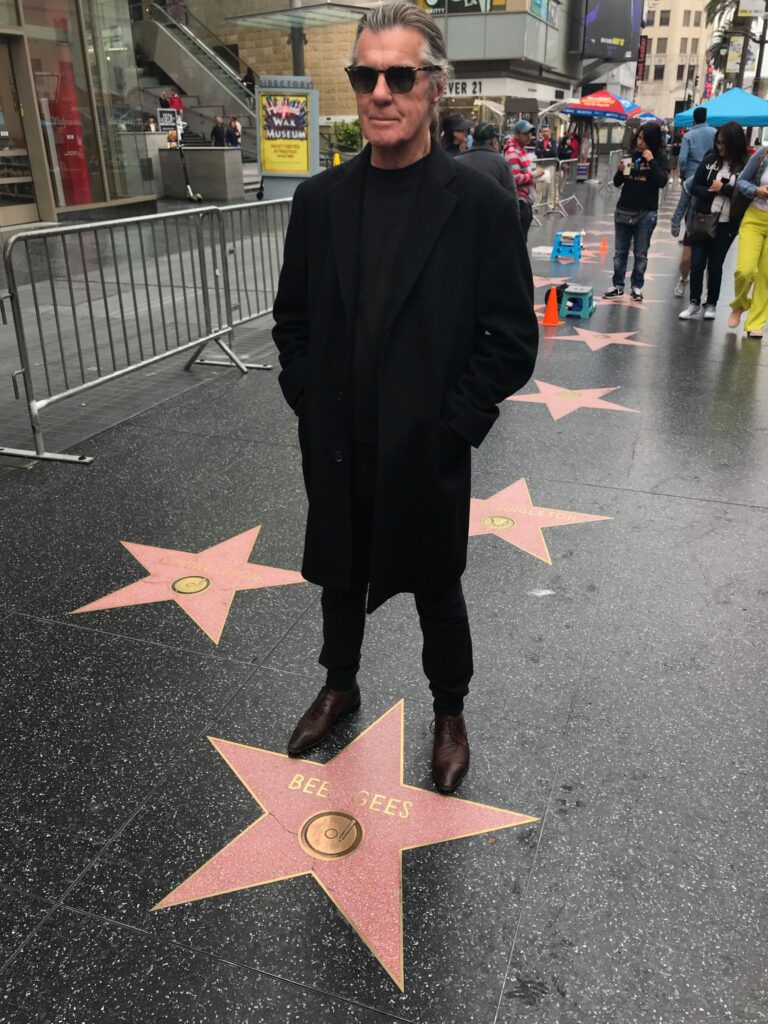
Vince Melouney (original member of the Bee Gees 1967-69) also penned a foreword for the 1960s book, as well as autographed copies for pre-orders. How valuable was Vince‘s insight to your research?
Andrew: Having seemingly disappeared from the music scene for a long time, Vince has become far more visible in recent years. He’s recorded some new material, both as a solo artist and as a member of a new group called Tall Poppy Syndrome, and he’s also been a special guest on tour with The Italian Bee Gees. I did a week on the road with them in April 2016 and spent a great deal of time interviewing Vince during this time. One chat we had after breakfast at a hotel in Berlin went on for about five hours. He’s led an interesting life and has so many great stories to tell.
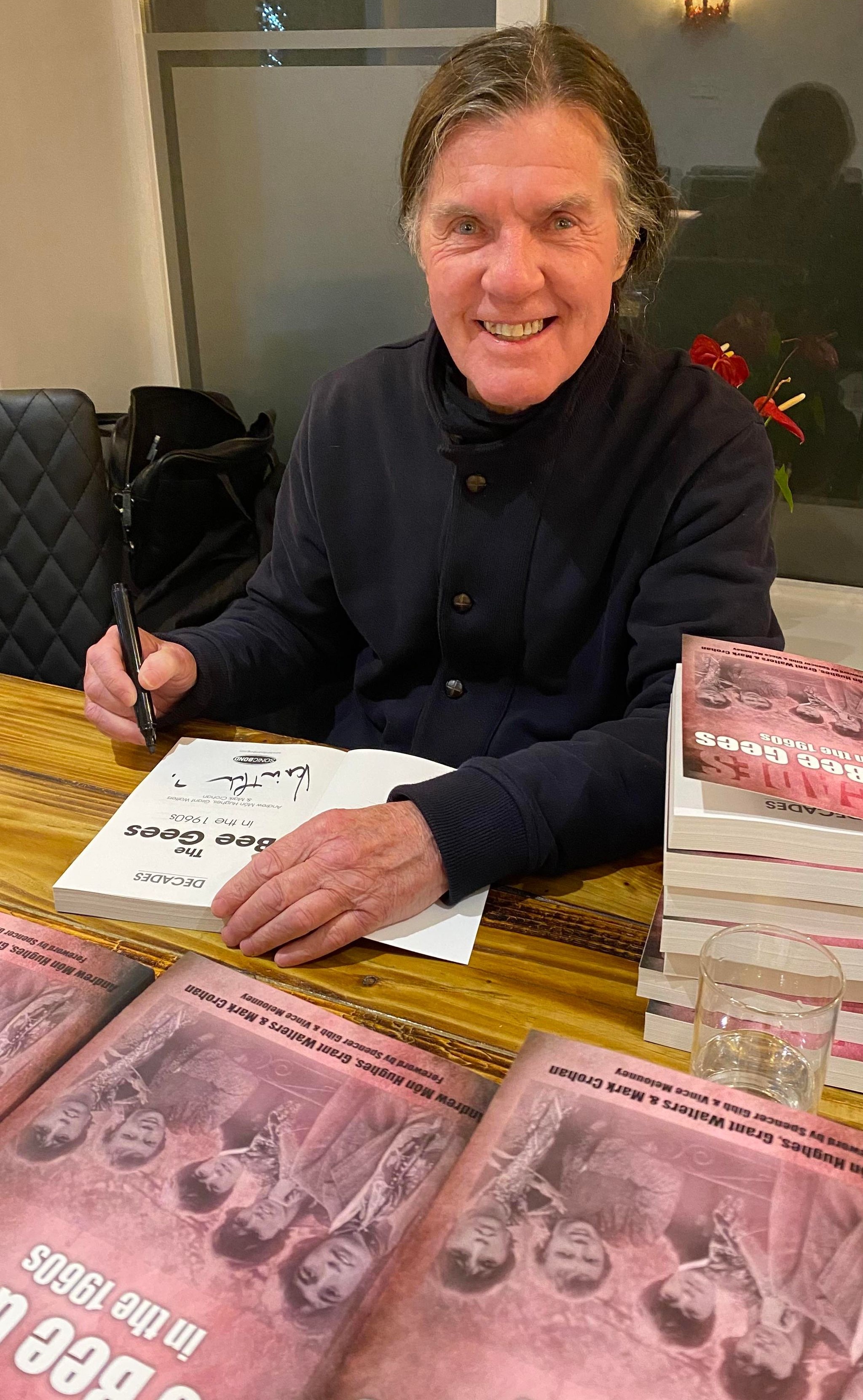
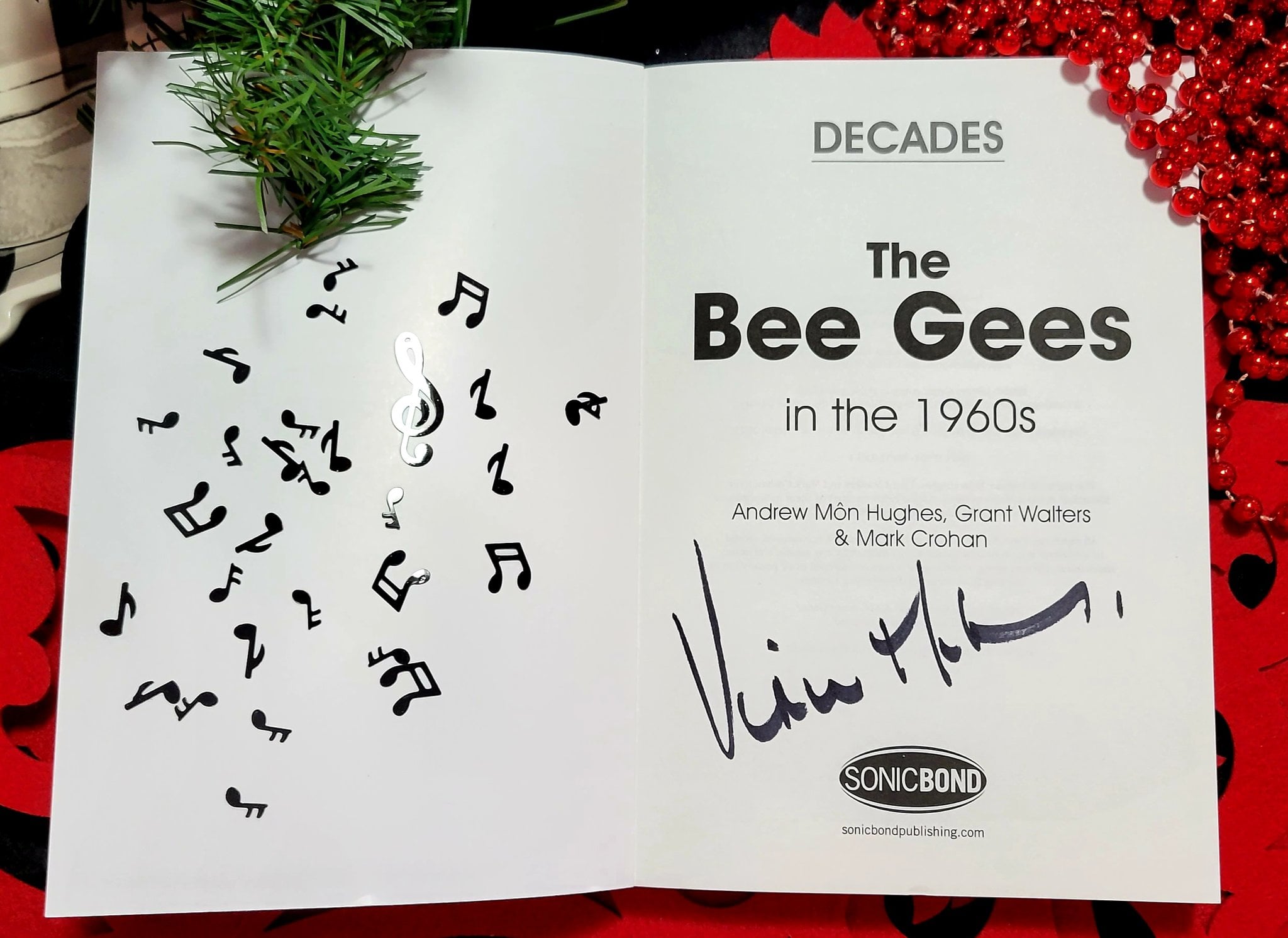
He’s living in the UK now, and that made him far more accessible to me, so when he agreed to write a foreword for the 1960s book, it made total sense to involve him a little more, so we asked if he’d be willing to sign copies for everybody who pre-ordered books directly from us via our website. Of course, he agreed, but for me it was a logistical nightmare – the books arrived while he was on tour in Germany, so hooking-up took a bit of doing, but we finally managed it. I think those who ordered the signed books are very happy to have one signed by an actual Bee Gee! (Jayne‘s note… yes! I cherish my copy!)
What was the day-to-day work like for you all? Not living close, different continents in fact, how was your communication handled?
Andrew: We had occasional Zoom conferences for major discussion points. Living in different time zones made it interesting – Grant would be having his morning coffee, I’d be having my lunch and Mark would be drinking Horlicks before going to bed.
Apart from that, Facebook Messenger was very useful for clarifying things quickly, and more complex issues were just noted in the work documents in Dropbox.
It was far easier than you’d imagine – again, being in different time zones meant that we wouldn’t all be wanting to work on things at the same time.
What was the process like of requesting assistance from those who were there during these eras? Were you successful at obtaining eventful information first-hand? How open were individuals to sharing details, and do you think that some of these new relationships will be helpful as you move forward through the decades?
Mark: Fortunately, we know our material pretty well, and there are many sources from which to research the various eras and actual occurrences. Sometimes speaking to people who were there only confuses things, as their memory has faded or sometimes varies from known facts. In the case of the 1960s book in particular, many of those people who were there at the time have passed.
How many books are you considering to publish in the series? Has the solo work of the brothers also been included and will there be anything shared beyond the death of Maurice in 2003?
Grant: For now, we’re committed to four books, but we’ve been toying with the idea of possibly writing a fifth, but that’s only been a discussion between the three of us that hasn’t gone further at this point. Presently, the fourth volume of the series is being proposed as a “90s plus” concept, where we could also address the years 2000 to 2003 when the Bee Gees effectively came to an end with Maurice’s passing. But there are many other related projects and stories we’d like to talk about through the present day – Robin and Barry’s solo albums, reissues, etc. We just need to determine what format would be best suited, but we do intend to bring everyone as up to date as we can.
Andrew: I’m hopeful that sales of these four volumes will encourage the publisher to allow us to add a further final book to complete the story – the 2000s. It’s not entirely in keeping with the Decades concept as it would have to cover 2000 to the present day, but there’s plenty of material there to justify doing this.
Mark: We don’t know if there will be anything new to talk about after Barry’s Greenfields record, really – he’s said in a couple of interviews that he’s now retired. The subtitle of it says The Gibb Brothers Songbook, Vol. 1, but it’s possible it’ll suffer the same fate as their 1994 song How to Fall in Love, Pt. 1 from Size Isn’t Everything. There never was a Pt. 2 to that, either!
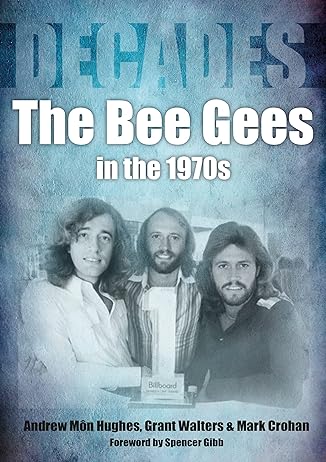
With the release of the second book in the series, was there anything you found along the way that you would have done differently in the first book now that you have completed the second?
Mark: No we generally followed the same process with both books. Why tamper with a proven method?
What did each of you encounter as the most difficult obstacle while working on the project to date?
Andrew: The Editor … the f***ing Editor! The guy who was hired to edit the 70s book did so much damage to the project in many ways. We had to make so many corrections to his corrections that it delayed publication significantly, as evidenced by continually changing publication dates for those who had pre-ordered the book. The process added at least six months to the project.
Mark: Closely listening to Robin’s unreleased, and to be fair, unfinished recordings of the early 70s and trying to write something positive about some of them. The lyrics are extremely abstract, nonsensical (at times) and quite depressing. On the bright side, on some tracks I found some lovely moments amongst them.
Sometimes it’s interesting reviewing a song or an album where one person likes or dislikes it and the others may have a contrary view. Somehow, we work together to combine all our thoughts. Sometimes it forces the other party (or parties) to review the item in question with a different mindset. It’s quite healthy.
Were there any facts that surprised you or you hadn’t realized were significant before you started researching the Bee Gees? Common misconceptions?
Andrew: Finding something new, even a tiny detail, is exciting for me. Probably my favorite from the 1960s book was when I found the exact departure details of the journey back to England.
Mark: Not so much a misconception but we found a wonderful anecdote about Barry Gibb from a former recording engineer for the band Chicago about a time the Bee Gees and Chicago worked together. It just shows how freakishly talented Barry Gibb is. I love that anecdote.
Andrew: This is one of my favorite eureka moments! Watch and listen very carefully to this clip of The Bee Gees performing Wouldn’t I Be Someone and Saw A New Morning live on The Tonight Show Starring Johnny Carson in 1973 and see if you can figure what’s different about it. (Keep reading for the answer!)
I know the fandom was very excited as they looked forward to the second instalment covering the 1970s and the Saturday Night Fever era. How daunting was it to tackle these years of the band’s public and private success, failure, and mega success?
Grant: The 1970s were a trip to cover for us, because at the start of the decade, the Bee Gees were non-existent. By the end, they were arguably the most successful band on the planet. There were so many highs and lows in between, and so much material. After 1975, they’d become writing and production machines, and the quality and quantity of music they made was simply astounding. The three of us are very familiar with all the intricacies but committing it to a published volume left us in awe several times. They really were prodigious – the stuff they and their co-producers and band mates piloted and pioneered was just so impressive. I don’t know if many other artists could have pulled themselves out of the kind of creative rut the Gibbs experienced in the mid-part of the decade and made the complete, stunning turnaround they did. They always had the potential to do that, but they needed confidence and direction. Thank God for Arif Mardin, and later Albhy Galuten and Karl Richardson. They gave the Bee Gees the support they needed to embrace their greatness.
Mark: But, even when they were having a tough time artistically and trying to figure out their next steps in 1973-1974, they were still brilliant singers and writers. The first half of the book was perhaps the hardest to write because they were involved in so many different projects during and after their breakup. They were into everything – really trying to throw lots of things against the wall to see what stuck. We got some really phenomenal songs from that era, even if things were commercially a bit slower for them – How Can You Mend a Broken Heart, Lonely Days, Run to Me, Walking Back to Waterloo, Alone Again.
Andrew: Going back to the clip of Wouldn’t I Be Someone and Saw A New Morning – most people could listen to this dozens of times and wouldn’t be able to tell the difference between the studio arrangement, and the unique arrangement used for this television appearance. But when it’s pointed out, it’s so blatantly obvious. Here’s the story…
During the 1973 US tour, there was a four-day break which allowed the entourage to travel to the West Coast for the next run of shows. Although there was some time to relax and recharge their batteries, there was still some work to be done. On March 27th, the Bee Gees recorded their first appearance as guest hosts on the popular late-night music show The Midnight Special.
The next day, they appeared on The Tonight Show Starring Johnny Carson. They performed live versions of Wouldn’t I Be Someone, in all its full-length glory, and a bombastic rendition of Saw A New Morning.
The booking for this show was made very late and required the Bee Gees‘ Conductor for the tour, Glyn Hale, to re-write the usual orchestral score to create unique arrangements on the flight to Los Angeles as the show’s resident musicians, the Doc Severinson Big Band was predominantly brass and saxophones, and didn’t include any strings which featured heavily on the studio recordings.
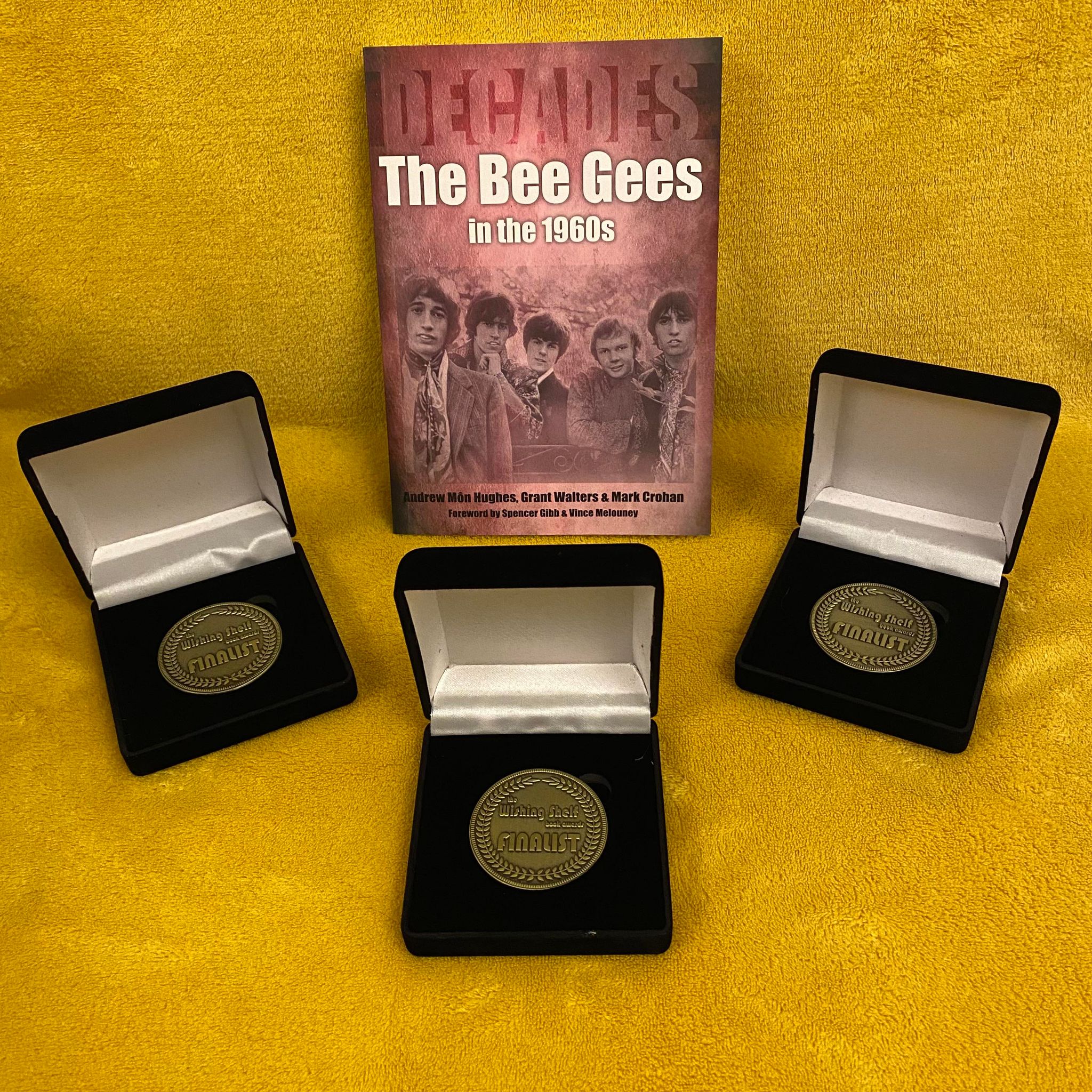
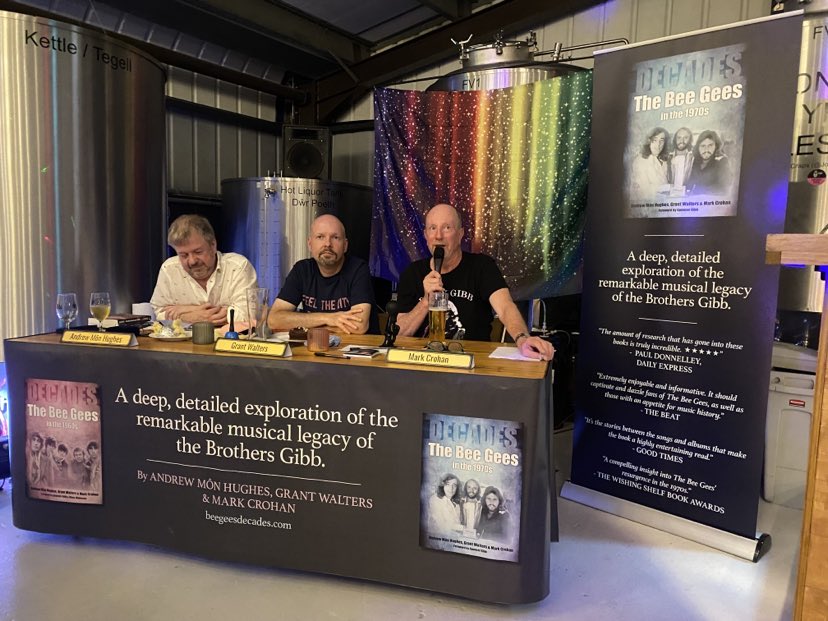
Before we close out, Andrew wondered if we’d like to take a peek at the authors recent trip where they had appearances doing table talks, media promotion, and a little sightseeing as well! This was actually the first time they had all met each other in person! I thought it would be really fun to include, so here you go! Commentary by Andrew…
In September, the three of us got together in person for the first time and we took the opportunity to do a bit of promotion for the books in between some sightseeing.
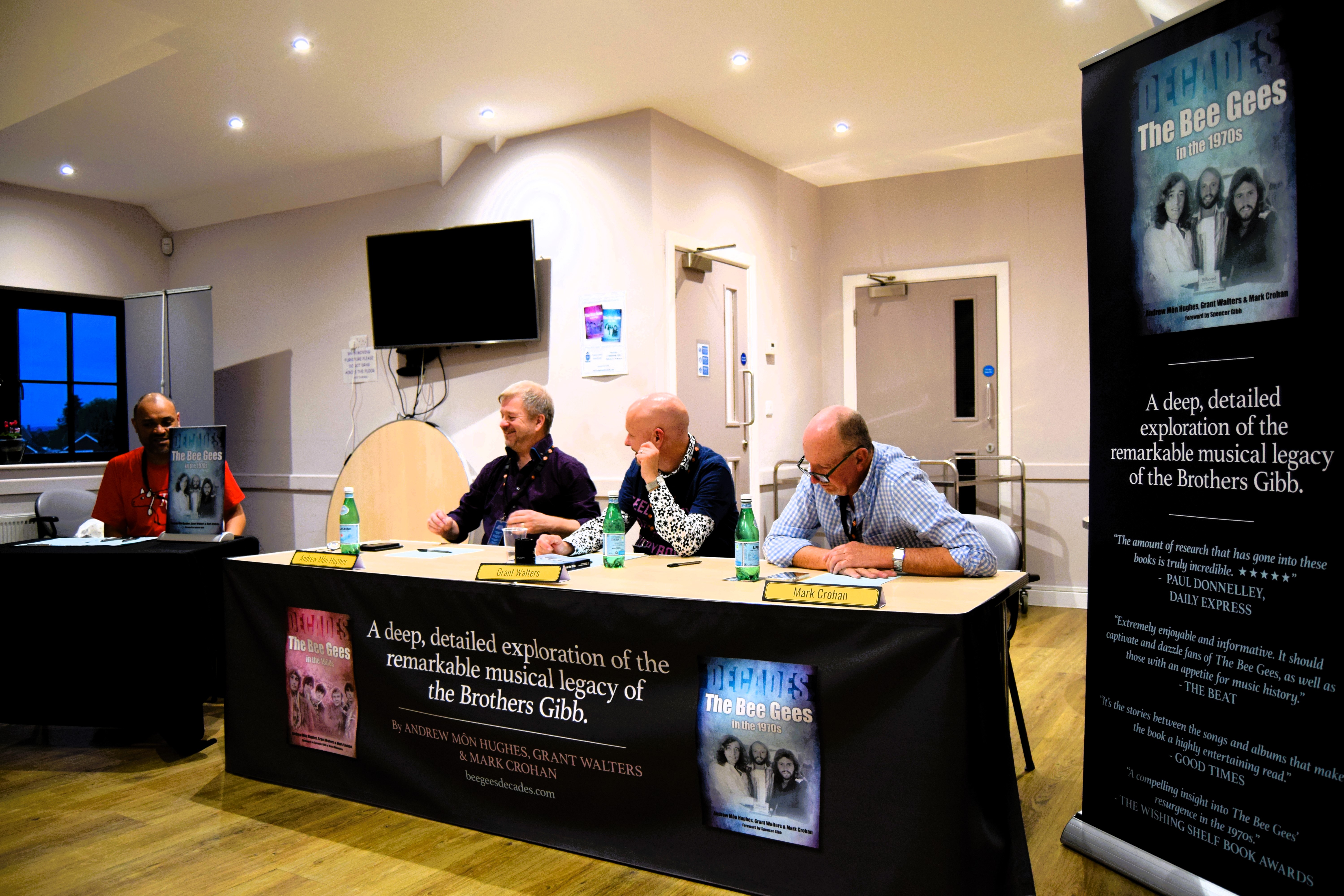
We started out in Thame, Oxfordshire, which is where Robin lived from 1983 until he passed away in 2012. He is buried at St. Mary’s churchyard which is directly opposite his house, The Prebendal.
In the morning we visited Thame Museum to see the newly opened permanent Robin Gibb exhibition. In the evening, we did the first of our book talks at Thame Town Cricket Club – a tenuous homage to The Bunburys – the event was well attended by Bee Gees fans. It was great to see so many old friends after so many years – I hadn’t seen some of them since the last Bee Gees convention that I’d organized in 2003.
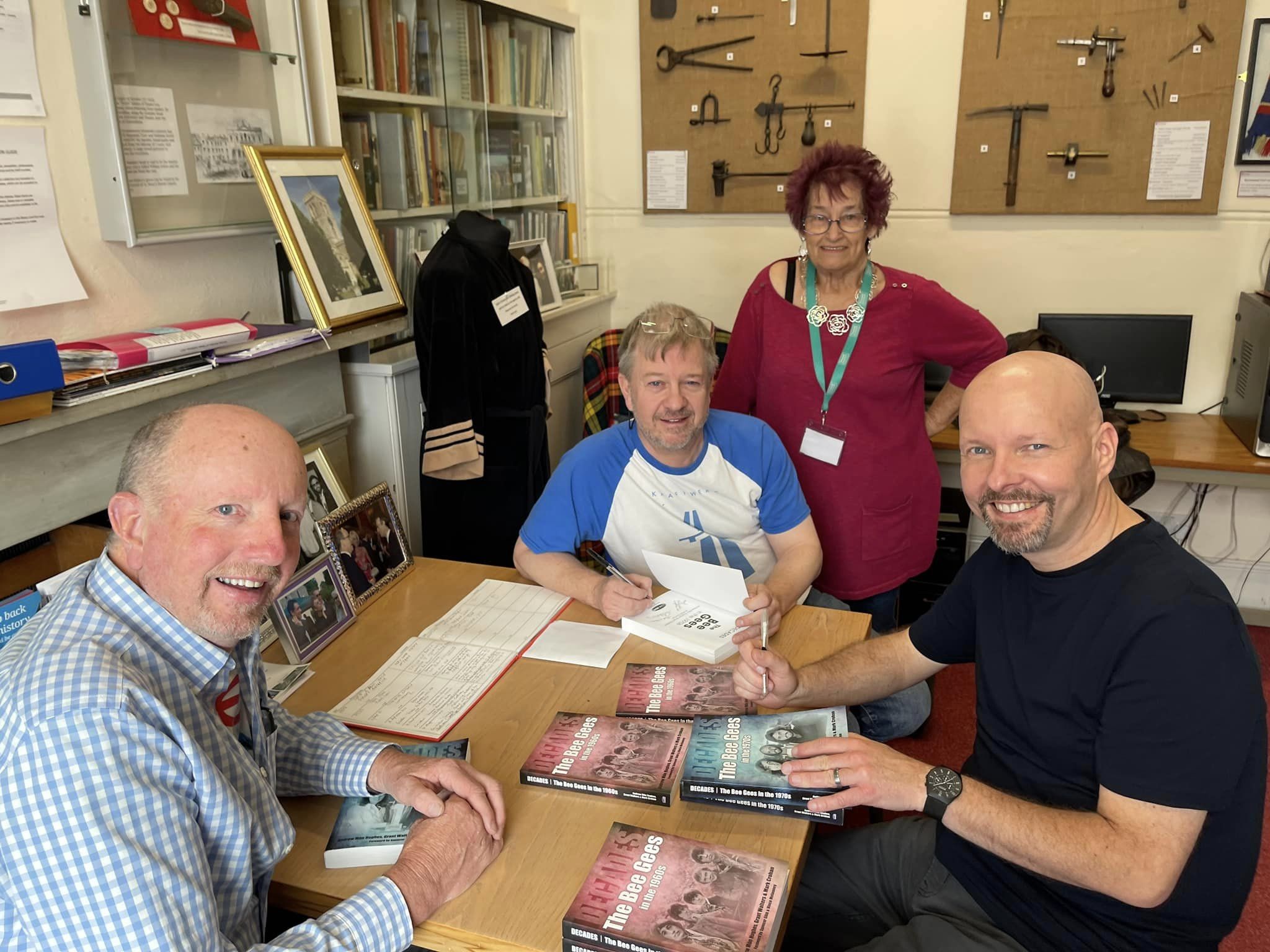
We did some sightseeing after that, travelling to Stonehenge and then to see the incredible Roman baths in Bath. The next day we travelled to Tewkesbury where we visited the magnificent abbey, and we met with our Publisher, Stephen Lambe of Sonicbond Publishing.
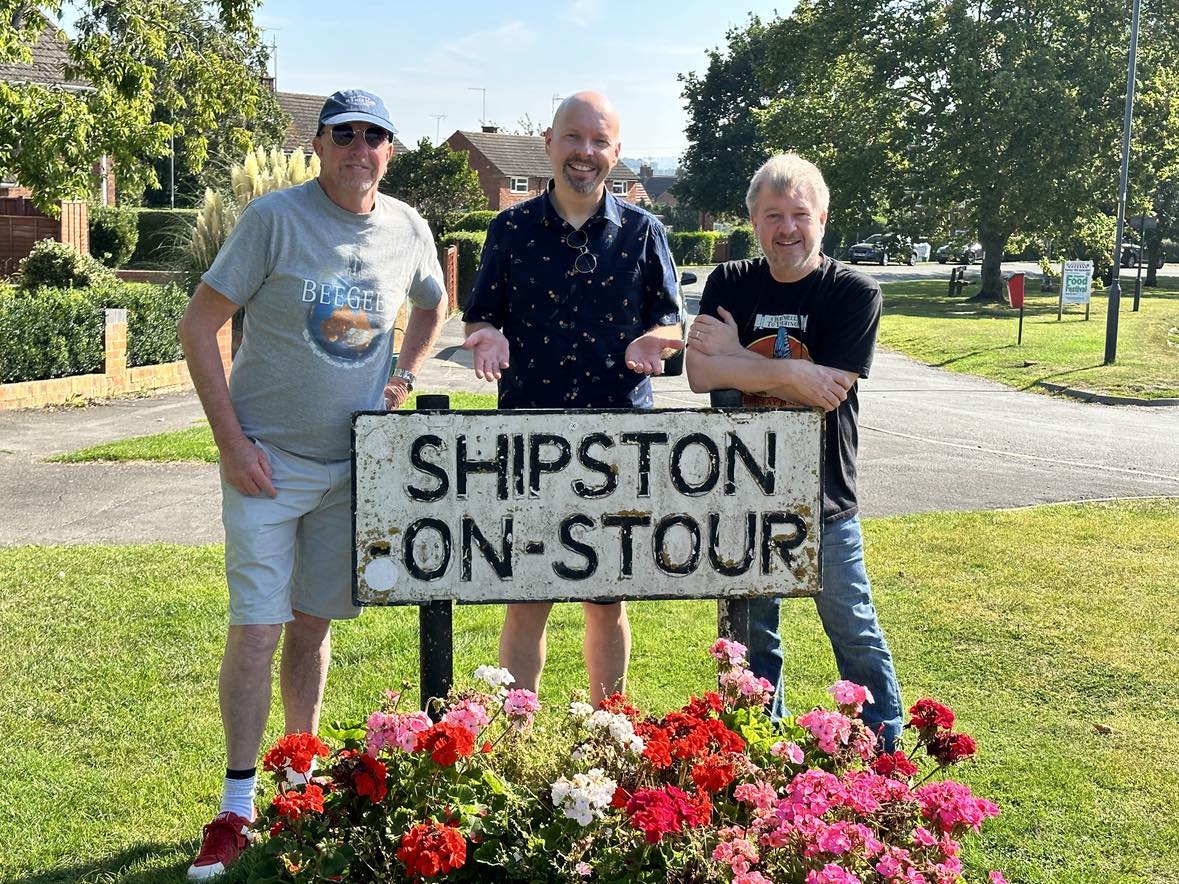
On the way to Stratford-Upon-Avon to see the birthplace of another reasonably famous author called William Shakespeare, we stopped off for a photo-op in Shipston-On-Stour – famed for its mention in Robin’s song Cold Be My Days. And then it was off to Warwick Castle before heading home to North Wales for a few days.
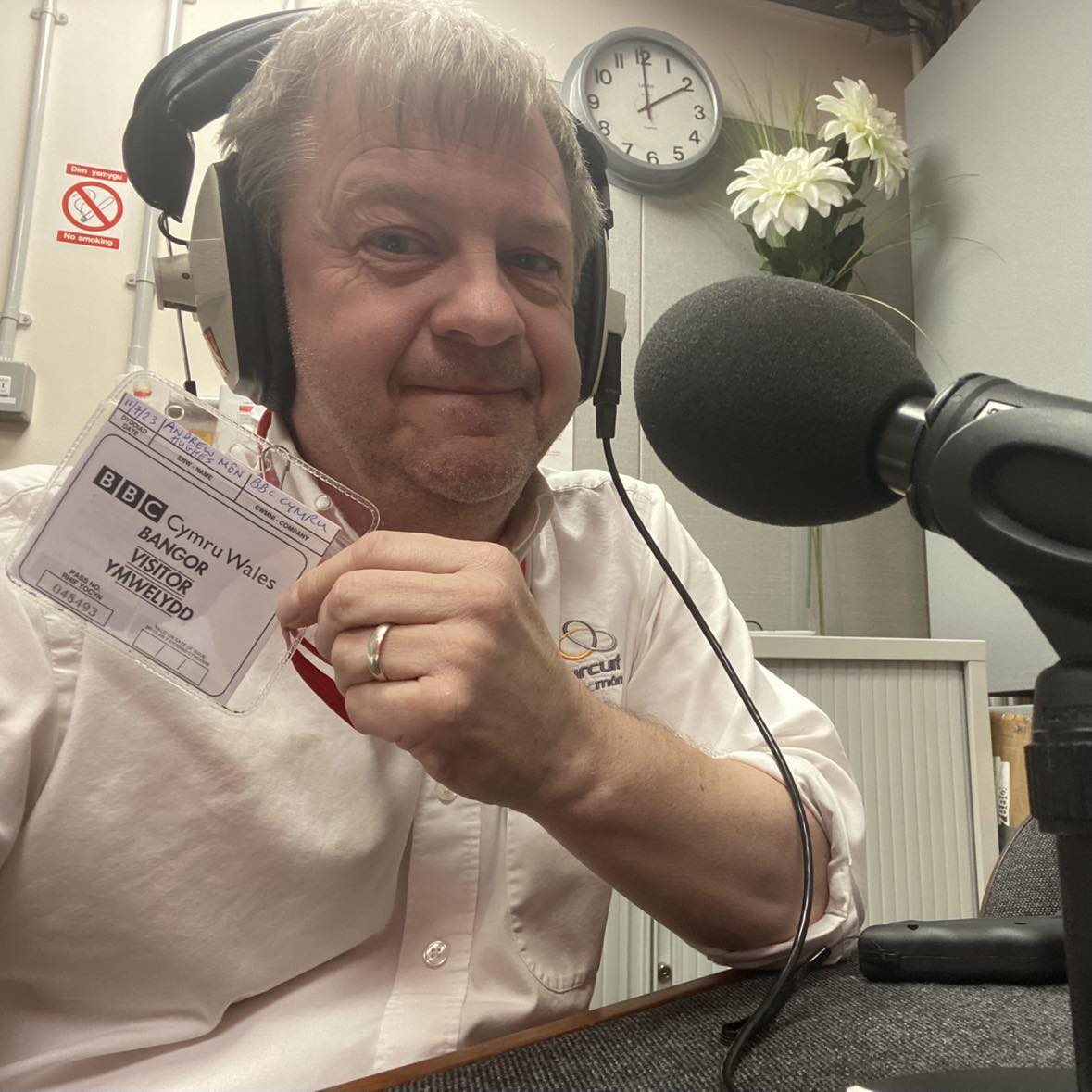
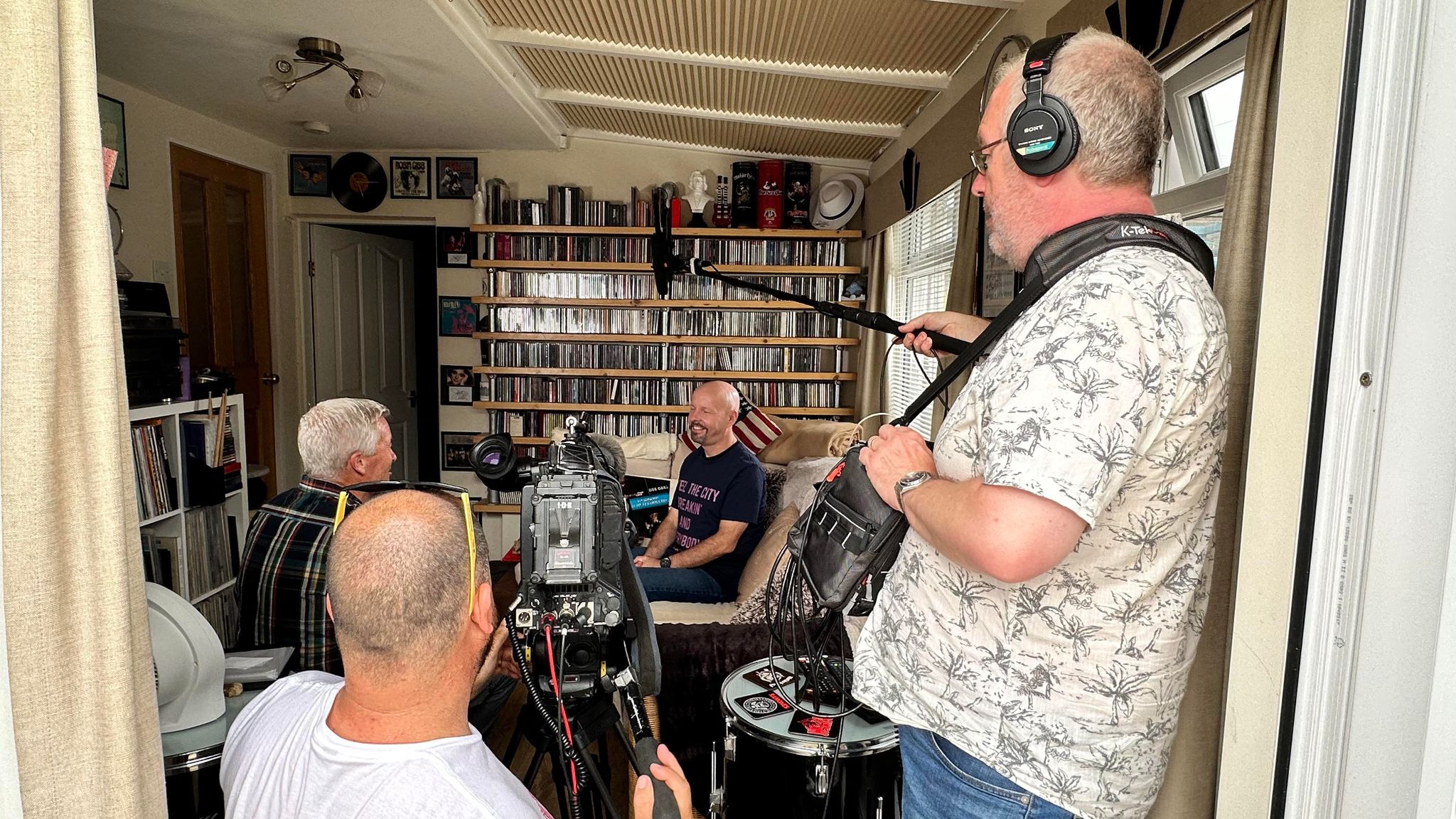
We did some radio work and we even had the Welsh television channel, S4C’s evening magazine program Heno record a piece with us prior to our book talk at Bragdy Cybi, our local microbrewery. It was book club night there, and we packed the place out – the audience had obviously heard that we’d be serving cake during the interval!
Then it was off to Wrexham Football Club as Grant’s a big fan of the Netflix series with Ryan Reynolds and Rob McElhenny who bought the club, followed by a quick tour of Beatles sites in Liverpool including Penny Lane and Strawberry Field. We spent the evening at The Cavern Club where we saw the resident band, The Cavern Beatles performing.

Our final day was spent in Manchester with The Bee Gees’ cousins, Hazel and Justine Gibb who showed us around St. Matthew’s Church in Stretford where Hugh and Barbara Gibb were married. After visiting one of the old family homes at 51 Keppel Road and the obligatory photograph on the steps, we walked the same route as the brothers did to the Gaumont Cinema, which, quite conveniently is just a stone’s throw from Oswald Road School where the brothers attended for a time. Even more conveniently, the old Gaumont is located next-door to a pub called the Sedge Lynn which is always a good stop-off for lunch.
The final stop on our whistle-stop tour was the fabulous Victoria Baths where much of Barry’s Now Voyager video was filmed. It’s an amazing building with three different pools, all of which were used in the video, plus the sauna, aerotone, and the splendid green tiled staircase in the entrance hall.
After that, it was off to the railway station for Grant and Mark to continue on their travels.
It was great to be able to spend the week together – hopefully another opportunity will present itself in the not-too-distant future.
Thank you Andrew, Grant, and Mark, so much, for sharing with us the beginnings of your journey. The first two books of the series are now available through Amazon directly or a link through the Decades website. You may also find them on Facebook, X/Twitter, and Instagram!
In closing, please note that all photos are credited to the authors unless otherwise indicated. I also have a couple of personal thank-yous to share for assistance with the Feature… to Theresa O’Donoghue and Jacqui Andrews for the use of their photos. To Luna Collins for her invaluable friendship. To Andrew, Grant and Mark for their willingness to share their process and their patience with me and my brain fog. And to my online Bee Gees fan family and specifically my Bee Gees Ladies for their continued support as we continue to strive to keep the music alive.
 At a Glance...